Tuesday, 18 September 2012
Paddle your own canoe
Back at the beginning of August I spoke at The Singing Entrepreneur forum. It was great, and I keep on referring back to the time there and considering what we were discussing. This next post is where my thoughts have been headed since the huge amount of information we heard went into my head... Particularly my thoughts on auditions - given how many of us are preparing for them in the busy autumn season.
I was at TSE to speak generally about my experiences, and the fact that my experience has accumulated outside of the traditional route through training. This doesn't mean I don't have any training, but it is perhaps more ad hoc in that I don't have any specific guidance or a time-scale. This has upsides and downsides.
Firstly, what do we want from our training? I decided I wanted the following (one not being more or less important than any of the others):
Language
Great teaching
Great coaching
To understand the system
To understand my voice - fach
Confidence/Stage experience
I have managed to acquire all of these things through my own tenacity (my Mum's word!) and determination. I am lucky in that I have experienced more upsides than downsides and things have gone well for me. When telling people what I am up to I would never lie and say that is easy doing it 'privat', but nor would I say that it is impossible. We make our own opportunities. We cannot just take what is given to us, but we should seek our own future and make it happen.
It's all very well and good me saying that from my little pedestal in Germany, but how does it actually happen?
I'm afraid that I don't know!
But what I do know is that BEING HERE was the key. By being here I am doing something different. Taking a risk. Ok, nothing is guaranteed to come from it, but nothing is guaranteed anyway. Had I not come to Germany I would never have met the brilliant coaches I work with here. Had I not come to Germany I wouldn't have been singing in the three productions I have performed in this summer, or be preparing to go to Israel in two weeks. Had I not come to Germany I would not have had the incredible teachers that I have worked with. Had I stayed at home....? I am not sure all of this would have happened. In fact I know that it wouldn't have happened and instead I would have been taking what opportunities I could from my hometown and focusing on re-trying to audition for music college. In effect, I would not have been progressing in the same way.
I essentially moved to Germany (and then everything else that followed) because I wasn't successful in some auditions last December. This doesn't mean the auditions weren't a success, but they became successful through what I did with the experience.
And from that, I learnt a rather important lesson: an audition is NOT a validation of whether or not you can sing.I repeat:
AN AUDITION IS NOT A VALIDATION OF WHETHER OR NOT YOU CAN SING.
The fact that you can sing is actually a given. If you are auditioning at a high level, say postgraduate or opera school or professionally. Of course you can sing! The question then, is whether you suit the institution that you are auditioning for at that time. What skills do you bring to them that they need, and are they equipped to help you on your path? Do you suit each other?
What do we think classifies as a career? I personally do not think a career is validated by competition wins, or places at prestigious schools. Thinking of a career as points based, where you get an A or a stamp for doing well isn't actually preparing a young person for their career. We should be grateful to be making music and communicating with our audiences, not thinking in terms of a defined 'career path'. We have to paddle our own canoes (copyright Emma Grossmith) and not worry about what everyone else is doing. We are all different, all our voices are different, that's what makes this so wonderful and fascinating. We do not need to do the same thing.
As far as I see it, the actual path is unimportant - it's what you make of it. Not everybody who follows the traditional route gets the same career. And the light at the end of the tunnel (ie a contract or regular work) is actually where the hard work begins, then the challenge is to continue....! When it comes to auditions, don't see it as a text of ability, see it as a chance to share your voice and musiciality with the others in the room. Enjoy it... And paddle your own canoe.

Friday, 31 August 2012
Down time. Or not?
So here comes the perpetual worry of being a freelancer.
Is this my last job? Will I ever work again?!
Ok. Perhaps not quite so dramatic as that. But it doesn’t seem uncommon to me, that when you accept a short-term contract (opera or otherwise), there is a moment or two of panic about what comes next at the end. I think that’s normal. But perhaps it doesn’t have to feel so negative if we accept it as part and parcel of our jobs. That actually, not always having the next thing to rush into can be a good thing?
We finish our run of Carmen this Sunday. It has been such fun and forced my summer to be incredibly busy. My German has improved (though I have MUCH more to learn) and it’s been great meeting and working with new colleagues and friends. It’s over on Sunday, so what happens next? At first I found the thought a bit daunting. I felt bad for not having another opera or performance to do immediately. Does this make me no good? It occurred to me about two weeks ago that my diary was looking horribly, horribly empty when I turned the pages into September. But, I have a recital and a Messiah to prepare for, auditions and competitions to do so I need to be working on a lot of repertoire. I knew I would still feel busy so the diary didn’t look so depressing when I decided to be rational. I was actually really, really, looking forward to a wonderful quiet month or two in Autumn to put my nose to the grindstone and fill that free time with study and preparation!
Filled with joy though I was about this, it hasn’t worked out as an empty diary after all.
The thing about a contract ending, is that cliche; it’s actually another door opening. I have just this week accepted the opportunity to go to Israel and sing a Bach Matthew Passion with the same group that I have been doing Carmen with. I had been planning on returning to the Bel Canto Bella Voce master class series in Vienna to work on repertoire preparation, which is occurring at the same time. And whilst gutted not to be there, working in Israel should be fun too! So the first two weeks of October are full touring cities including Tel-Aviv and Jerusalem. Then, this morning I enrolled at a language school starting on Monday. Now the first three hours of every day are full of German fun for the next month. On top of all this I have to fit in my teaching and part-time finance job. Oh, and learn all that repertoire mentioned above.
Where has my study time gone?! I have gone from panicking about not having anything to do, to once more not having time to do anything.
I think the skills of being a freelancer have to include making your own work (of course), but also then trusting that it will come. From the amount of preparation you put in, more work is spawned. Down time is not down time to be depressed and worry about ‘the career’, it’s the time to ask yourself what is important to you and what you want to do more of. Investing more in German is important to me. I find it incredibly frustrating not being able to say what I want to say, and I am quite preoccupied with getting the German grammar right. So I’m doing another month language course to rectify that. It’s also really important that I present myself well for the performances that are coming up in a month or two so I don’t really have any down time at all.
Pavarotti was quoted (I’ve seen the youtube clip) as stating that the secret to his success is, “Concentrazione, concentrazione, concentrazione”. I think I would like to add “Preparazione, preparazione, preparazione” to the Maestro’s ethos...
Is this my last job? Will I ever work again?!
Ok. Perhaps not quite so dramatic as that. But it doesn’t seem uncommon to me, that when you accept a short-term contract (opera or otherwise), there is a moment or two of panic about what comes next at the end. I think that’s normal. But perhaps it doesn’t have to feel so negative if we accept it as part and parcel of our jobs. That actually, not always having the next thing to rush into can be a good thing?
We finish our run of Carmen this Sunday. It has been such fun and forced my summer to be incredibly busy. My German has improved (though I have MUCH more to learn) and it’s been great meeting and working with new colleagues and friends. It’s over on Sunday, so what happens next? At first I found the thought a bit daunting. I felt bad for not having another opera or performance to do immediately. Does this make me no good? It occurred to me about two weeks ago that my diary was looking horribly, horribly empty when I turned the pages into September. But, I have a recital and a Messiah to prepare for, auditions and competitions to do so I need to be working on a lot of repertoire. I knew I would still feel busy so the diary didn’t look so depressing when I decided to be rational. I was actually really, really, looking forward to a wonderful quiet month or two in Autumn to put my nose to the grindstone and fill that free time with study and preparation!
Filled with joy though I was about this, it hasn’t worked out as an empty diary after all.
The thing about a contract ending, is that cliche; it’s actually another door opening. I have just this week accepted the opportunity to go to Israel and sing a Bach Matthew Passion with the same group that I have been doing Carmen with. I had been planning on returning to the Bel Canto Bella Voce master class series in Vienna to work on repertoire preparation, which is occurring at the same time. And whilst gutted not to be there, working in Israel should be fun too! So the first two weeks of October are full touring cities including Tel-Aviv and Jerusalem. Then, this morning I enrolled at a language school starting on Monday. Now the first three hours of every day are full of German fun for the next month. On top of all this I have to fit in my teaching and part-time finance job. Oh, and learn all that repertoire mentioned above.
Where has my study time gone?! I have gone from panicking about not having anything to do, to once more not having time to do anything.
I think the skills of being a freelancer have to include making your own work (of course), but also then trusting that it will come. From the amount of preparation you put in, more work is spawned. Down time is not down time to be depressed and worry about ‘the career’, it’s the time to ask yourself what is important to you and what you want to do more of. Investing more in German is important to me. I find it incredibly frustrating not being able to say what I want to say, and I am quite preoccupied with getting the German grammar right. So I’m doing another month language course to rectify that. It’s also really important that I present myself well for the performances that are coming up in a month or two so I don’t really have any down time at all.
Pavarotti was quoted (I’ve seen the youtube clip) as stating that the secret to his success is, “Concentrazione, concentrazione, concentrazione”. I think I would like to add “Preparazione, preparazione, preparazione” to the Maestro’s ethos...
Sunday, 19 August 2012
WORK ethic
This month has been a bit crazy. Going straight from speaking at The Singing Entrepreneur and Co-Opera in London at the beginning of the month into production rehearsals for Carmen at the Seefestspiele in Berlin has been manic! In the run up to the show we were called almost every day for long days in a rather warm rehearsal room. Then, rehearsing on the main stage (Hauptbühne) for the Klavierproben, Klavierhauptprobe 1 + 2, Generalprobe. Exciting, and a great learning experience. We are now into the performances (see the Premier screened here online on the ARTE website) and will be going until the 2nd September.
People are always asking me if I am getting to 'do a role' in the production. Well, I have done Frasquita in opera excerpts recently and know the role, but I am proud to say that I am in the chorus. For several reasons: firstly, it's work, WIN. Secondly, it's paid, WIN. Thirdly, the director and conductor and soloists are amazing. Fourthly - and this is the most important - everyday we are on stage, learning our craft. Getting to sing on a big stage to a big audience, with a professional orchestra and crew, is one of the best things that I think we could be doing as young singers. Each day is a masterclass as we watch the soloists pacing themselves through roles, seeing how much they give emotionally and the limits they push themselves to as they act through the role. We get to watch them play and in turn we get to play ourselves. We are challenged to work as a group and make the experience as enjoyable and exciting as possible for the public. How far can we go, what journey are we on, how much can we express - physically and vocally? Of course we would do the same if we were soloists too, but this is all about baby steps, and this is a stepping stone to understanding and taking the plunge to doing something similar ourselves in the future.
It is great to be required to be at 'work' in the evening (to me it still feels too much like fun so calling it work is weird), but it has set me thinking about my work ethic in general. It would be very, very easy to go along, have a good time, mess around backstage, stay after and have a few drinks, get up late etc etc etc... BUT. Please don't call me a Nana, but I don't want to do that. I want a better work ethic. I want to make the most of this opportunity and not become complacent just because I have some work. So, I have regularly taken to sitting backstage (normally in front of a beautiful Wannsee sunset so no complaints) with the score to my next project. This varies depending on mood from lieder to opera or books I'm reading as research, but it's all relevant. Perhaps I am some über-driven, hyper-motivated workaholic, but I think it's important to manage time properly so that you can relax and have proper down time when it comes.
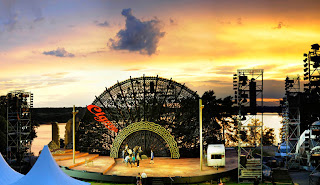
This leads me onto my next point. I think time management/being intelligent with our time is just as important when it comes to practice as well as learning. There is NO POINT in constantly singing. No point. I actually try to sing as little as possible. My practice is mental, in my head, and magically my voice doesn't tire. At the same time I become more aware and conscious of the harmony and orchestration and the musical and character decisions I wish to make. Then, when I do practice (i.e. the actual singing bit) I practice smart. This is a phrase taught to me by the wonderful singer I learnt with in Turn, and what she means is, there is no point constantly singing, or singing at all really, if you are just repeating stuff or 'singing things through'. You have to practice smart. And by that I mean, work things into the voice slowly, get the placement for each note, get the body conscious of that placement and use your emotional barometer to guide you. Maybe everybody instinctively does this, or is a dutiful student and has been taught how to work diligently and slowly rather than just bashing through. But I didn't, and learning to practice smart has made the most wonderful difference. Another thing I now LOVE to do (which I KNOW I was always told to do...) is learn the words first (inspired by another friend of mine who does the same - you know who you are!). Translate the poetry, speak it, feel it. I try not to even touch the music now until I have got the feel for the character's journey through the text.
At The Singing Entrepreneur weekend, a beautiful, talented friend of mine gave a speech that was very close to my heart, about the moves we make from Student, to Singer, to Artist and on to Diversifying. I found it wonderfully enlightening. What she said struck me, as it occurred to me that there is no time scale for this journey - Student to Singer to Artist. The speed you travel through need not be predetermined by your stepping stones through the training ladder. The only person who can move you to the next level is you. What do you ask of yourself? Is it enough to approximate the text and get the music just-about-right? Or is there more to be demanded?
What is the difference between the mentality of being a student, to being a professional singer, to being a bonafide artist? An artist who is independently making his or her own decisions from a real depth of understanding of the text and the score? Who challenges us to do that? I don't really have the answer to my own question I'm afraid, but my instinctive answer is that it is our own responsibility.
It all sounds a lot like hard work... But no one ever said it was easy. And... It's FUN!!!
People are always asking me if I am getting to 'do a role' in the production. Well, I have done Frasquita in opera excerpts recently and know the role, but I am proud to say that I am in the chorus. For several reasons: firstly, it's work, WIN. Secondly, it's paid, WIN. Thirdly, the director and conductor and soloists are amazing. Fourthly - and this is the most important - everyday we are on stage, learning our craft. Getting to sing on a big stage to a big audience, with a professional orchestra and crew, is one of the best things that I think we could be doing as young singers. Each day is a masterclass as we watch the soloists pacing themselves through roles, seeing how much they give emotionally and the limits they push themselves to as they act through the role. We get to watch them play and in turn we get to play ourselves. We are challenged to work as a group and make the experience as enjoyable and exciting as possible for the public. How far can we go, what journey are we on, how much can we express - physically and vocally? Of course we would do the same if we were soloists too, but this is all about baby steps, and this is a stepping stone to understanding and taking the plunge to doing something similar ourselves in the future.
It is great to be required to be at 'work' in the evening (to me it still feels too much like fun so calling it work is weird), but it has set me thinking about my work ethic in general. It would be very, very easy to go along, have a good time, mess around backstage, stay after and have a few drinks, get up late etc etc etc... BUT. Please don't call me a Nana, but I don't want to do that. I want a better work ethic. I want to make the most of this opportunity and not become complacent just because I have some work. So, I have regularly taken to sitting backstage (normally in front of a beautiful Wannsee sunset so no complaints) with the score to my next project. This varies depending on mood from lieder to opera or books I'm reading as research, but it's all relevant. Perhaps I am some über-driven, hyper-motivated workaholic, but I think it's important to manage time properly so that you can relax and have proper down time when it comes.

This leads me onto my next point. I think time management/being intelligent with our time is just as important when it comes to practice as well as learning. There is NO POINT in constantly singing. No point. I actually try to sing as little as possible. My practice is mental, in my head, and magically my voice doesn't tire. At the same time I become more aware and conscious of the harmony and orchestration and the musical and character decisions I wish to make. Then, when I do practice (i.e. the actual singing bit) I practice smart. This is a phrase taught to me by the wonderful singer I learnt with in Turn, and what she means is, there is no point constantly singing, or singing at all really, if you are just repeating stuff or 'singing things through'. You have to practice smart. And by that I mean, work things into the voice slowly, get the placement for each note, get the body conscious of that placement and use your emotional barometer to guide you. Maybe everybody instinctively does this, or is a dutiful student and has been taught how to work diligently and slowly rather than just bashing through. But I didn't, and learning to practice smart has made the most wonderful difference. Another thing I now LOVE to do (which I KNOW I was always told to do...) is learn the words first (inspired by another friend of mine who does the same - you know who you are!). Translate the poetry, speak it, feel it. I try not to even touch the music now until I have got the feel for the character's journey through the text.
At The Singing Entrepreneur weekend, a beautiful, talented friend of mine gave a speech that was very close to my heart, about the moves we make from Student, to Singer, to Artist and on to Diversifying. I found it wonderfully enlightening. What she said struck me, as it occurred to me that there is no time scale for this journey - Student to Singer to Artist. The speed you travel through need not be predetermined by your stepping stones through the training ladder. The only person who can move you to the next level is you. What do you ask of yourself? Is it enough to approximate the text and get the music just-about-right? Or is there more to be demanded?
What is the difference between the mentality of being a student, to being a professional singer, to being a bonafide artist? An artist who is independently making his or her own decisions from a real depth of understanding of the text and the score? Who challenges us to do that? I don't really have the answer to my own question I'm afraid, but my instinctive answer is that it is our own responsibility.
It all sounds a lot like hard work... But no one ever said it was easy. And... It's FUN!!!
Monday, 16 July 2012
No-Man's Singing Land
Would you like to sing?
Opera?
Yes.
That's great.
Well if you do there are a number of ways you can do that. It's going to take you about 8-10 years to train. There are no job guarantees at the end.
So are you sure you want to do this?
Yes.
Well. Firstly, go to music college at undergrad. And if you don't do that, then you should study languages at university. If you really want to, study music at university. You could also study pretty much anything else; law, philosophy, english literature, maths. Just keep having private voice lessons and get involved with university societies so you get stage and performance experience.
Then what?
After that you need to do a masters or postgrad diploma. Really focus on your technique for two years. Normally at a music college, though there are masters performance programmes at universities as well.
Then?
Ideally go to an opera school. After that you can also go on to an opera studio attached to an opera house, often in Germany (there are others in Flanders, Switzerland, Austria and France too).
After that?
Well, you may have an agent by this stage and already be working. But if not then, you should think about doing big competitions to get noticed and start applying to agencies.
What if I don't get noticed at this stage?
...
We have all been taught that there is a certain way to do this. The career. There is a route from undergrad, to postgrad, to opera school, to winning an amazing competition, to getting an agent and then having a wonderful career that then continues for decades without interruption. I am not sure (other than for the lucky few) that this is reality.
There are a lot of us. And there is a lot of talent. We all love it, we love music, we love making music, we love singing. Who gets to choose who can really have a successful career? Having the best and most beautiful voice in the world actually isn't enough. What is a successful career anyway? Does it include sleeping in your own bed every night and having a family, or does it involve traveling the world from one city to the next?
We have to be great musicians. We have to be entrepreneurial. We have to understand our own voices, what is good for them, suits them and what doesn't. We have to gain experience and excel when we do. We have to grab opportunity with both hands. We have to understand social media and marketing. We have to be GOOD people. Treat others as we wish to be treated.
I, in complete honesty, have NO IDEA what I am doing. Honest. I love where I live, I love the people I work with, I love that I can earn (some) money from the singing that I do, and choose the other projects I get involved in. I just turned 25 and I have huge admiration when I hear wonderful voices from wonderful people in wonderful places. I know that I am not in a rush, that I 'have time' and I am happy to take my time. I have the time to do a masters, an opera studio, get an agent etc. But time is not finite and there is a lot of work that I have to get on with so that I can be ready when the time comes.
Thinking of 'time'. There is this no-man's time, between when you are a student, and when you magically graduate to being a professional. I am trying something a bit different at the moment. Not being at college, living abroad, it probably all seems a bit random and whacky to someone outside looking in. But to me, languages are crucially important, so I am here to get my German to where my Italian is, working on my singing whilst I'm here. And maybe, just maybe, we don't all have to follow the same route to have a singing career. I think, with good sense, you can make your own opportunities and progress very well. But how long does this go on for? When do I graduate from my current little path to the path I would like to be on (which is of course where I have perfect technique, have a number of roles under my belt and get continuous professional work - hello Suzy the idealist)? Maybe this will NEVER HAPPEN.
But I bet - would put a lot of money - on the fact, that we will all continue, in whatever way we can, for as long as we can, as long as it is ok to hear 'No's' at audition and believe that you are still doing something right.
Opera?
Yes.
That's great.
Well if you do there are a number of ways you can do that. It's going to take you about 8-10 years to train. There are no job guarantees at the end.
So are you sure you want to do this?
Yes.
Well. Firstly, go to music college at undergrad. And if you don't do that, then you should study languages at university. If you really want to, study music at university. You could also study pretty much anything else; law, philosophy, english literature, maths. Just keep having private voice lessons and get involved with university societies so you get stage and performance experience.
Then what?
After that you need to do a masters or postgrad diploma. Really focus on your technique for two years. Normally at a music college, though there are masters performance programmes at universities as well.
Then?
Ideally go to an opera school. After that you can also go on to an opera studio attached to an opera house, often in Germany (there are others in Flanders, Switzerland, Austria and France too).
After that?
Well, you may have an agent by this stage and already be working. But if not then, you should think about doing big competitions to get noticed and start applying to agencies.
What if I don't get noticed at this stage?
...
We have all been taught that there is a certain way to do this. The career. There is a route from undergrad, to postgrad, to opera school, to winning an amazing competition, to getting an agent and then having a wonderful career that then continues for decades without interruption. I am not sure (other than for the lucky few) that this is reality.
There are a lot of us. And there is a lot of talent. We all love it, we love music, we love making music, we love singing. Who gets to choose who can really have a successful career? Having the best and most beautiful voice in the world actually isn't enough. What is a successful career anyway? Does it include sleeping in your own bed every night and having a family, or does it involve traveling the world from one city to the next?
We have to be great musicians. We have to be entrepreneurial. We have to understand our own voices, what is good for them, suits them and what doesn't. We have to gain experience and excel when we do. We have to grab opportunity with both hands. We have to understand social media and marketing. We have to be GOOD people. Treat others as we wish to be treated.
I, in complete honesty, have NO IDEA what I am doing. Honest. I love where I live, I love the people I work with, I love that I can earn (some) money from the singing that I do, and choose the other projects I get involved in. I just turned 25 and I have huge admiration when I hear wonderful voices from wonderful people in wonderful places. I know that I am not in a rush, that I 'have time' and I am happy to take my time. I have the time to do a masters, an opera studio, get an agent etc. But time is not finite and there is a lot of work that I have to get on with so that I can be ready when the time comes.
Thinking of 'time'. There is this no-man's time, between when you are a student, and when you magically graduate to being a professional. I am trying something a bit different at the moment. Not being at college, living abroad, it probably all seems a bit random and whacky to someone outside looking in. But to me, languages are crucially important, so I am here to get my German to where my Italian is, working on my singing whilst I'm here. And maybe, just maybe, we don't all have to follow the same route to have a singing career. I think, with good sense, you can make your own opportunities and progress very well. But how long does this go on for? When do I graduate from my current little path to the path I would like to be on (which is of course where I have perfect technique, have a number of roles under my belt and get continuous professional work - hello Suzy the idealist)? Maybe this will NEVER HAPPEN.
But I bet - would put a lot of money - on the fact, that we will all continue, in whatever way we can, for as long as we can, as long as it is ok to hear 'No's' at audition and believe that you are still doing something right.
Thursday, 5 July 2012
Fach it!!
Since being in Germany and spending time in Vienna, it has become much more apparent to me that fach is incredibly important here. It is important if you consider you and your voice a product; you have to have a selling point which you can pitch to prospective employers (agents, music colleges, competitions etc). Rep houses here in Germany employ singers according to their fach, using the system to make sure they have enough house soloists for each opera, before they contract in guests for other roles. There is (usually) always someone in the house who can sing each role in the operas they are doing.
The next section is hard to explain, and a bit specialist. I am presuming a little bit of knowledge of standard rep from my readers...! And I also apologise in advance that I focus on soprano rep. It is what I have done most research on and can speak about with confidence.
What is fach?
I have read some fantastic books on fach (Pearl Yeadon's 'Guide to Understanding the Fach System in Europe' is extremely helpful, as is Richard Miller's 'Training Soprano Voices'), and the definition of how you categorise fach seems to be a combination of factors. Age, colour, weight of voice, squillo (ring that cuts through an orchestra), amount of performance experience and desire - ie what you want to sing and which characters you instinctively have an affinity to - all play a factor. But what seems most important to me, is that fach is what is EASY for you. If it is hard for you to sing in a piece that consistently moves over the upper passaggio, or you are consistently tired after practicing, then chances are it isn't written for your fach; the composer wrote that because someone found it easy. Mozart refused to even begin composing until he had met the singer he was writing for. For some sopranos, although they are rare, the Queen of the Night is the easiest thing in the world to do (Aloysia Weber is the soprano Mozart wrote it for), so voices shouldn't be forced to do what is not natural for them. It is unlikely that that same soprano would find singing Susanna in Figaro a walk in the park. The role sits lower and is much more chatty with fewer moments of high sustained singing. This does not make it better or worse to be able to do one or the other, and there's a chance that some singers can do both, but one of them will certainly be easier. They are different and that is OK. We don't need to constantly be versatile, sometimes, knowing your market is a very good thing!
Size of voice is also important. The houses here in Berlin are big, so a much more lyric soprano than I was accustomed to in the UK will normally be employed to sing Pamina and Susanna - the same soprano will also sing Micäela in Carmen. The current taste for Countess seems to be actually more of a spinto/junglische dramatisch sound rather than a true lyric; pure tone with a lot of bite. This is simply to make sure the voices can be heard without pushing over big orchestras in bigger houses. So if you ever audition here in Germany, consider what their ears are accustomed to for different roles. A young lyric in the UK might prepare Countess (and expect to sing it), but in German reality, she's more likely to sing Susanna...
How can you hear what fach is?
Some of it is taste; listen to repertoire and listen to different singers singing the same repertoire - see what you like. What weight of voice do you like singing the music? What sounds like music to your ears? The easiest to compare to begin with are different singers, singing the same pieces of a composer like Mozart. Try comparing a Sally Matthews/Dorothea Röschmann/Miah Persson interpretation of Fiordiligi. What do you prefer, and what fach do they all fit under? I think Miah Persson is a much lighter voice, Dorothea Röschmann has the fuller, more lyric sound. Do the same for Pamina, or in the baritone world different interpretations of Figaro or Papageno. A tenor could compare Ian Bostridge to Juan Diego Florez or Rollando Villazon. Some will sound lighter, some richer, some more brilliant. It all makes up their fach.
Lots of people sing cross-fach now, or sing different rep according to the size of the house and the orchestra. As long as it feels like a good fit in your voice, don't feel completely pinned to one 'type' of repertoire.
How do you know what fach you are?
From a personal point of view, I have spent SO much time singing unsuitable repertoire. A few months ago my singing CV looked haphazard and confused. Who on earth would even consider inviting a soprano to audition who has a mixture of big lyric repertoire and soubrette pieces on their CV? What is she? What roles does she sing and excel at?
So I've slowly been figuring it out. And learning that it is OK (!!!) that my voice does not happily sit low and that I should sing repertoire that sits higher. It is alright that Susanna is hard for me, and that Zerbinetta is easy. As I mentioned above, fach is what comes naturally, or easily to you. We aren't all made the same, but it is so common that every sop sings Deh, vieni at some stage that it is surprising and sometimes disconcerting not to fit with the norm. I tried working on this piece recently in Vienna, just because I thought I should, and my teachers could NOT figure out why I couldn't sing it. Now, I am certainly not a Countess, but when we tried singing through Porgi amor (given how frustrated I was getting with Deh, vieni we decided to change tack) and it was like 'night and day'. It is easier for me to hang about the upper passaggio. But in terms of fach, I am not a Countess, I don't have the lyric lines, or weight of voice, but it sounds better than me singing Susanna any day. It does not mean I am a lyric or lyric spinto... I have to explore repertoire to figure our what does suit me.
I think we can begin to know what fach we are when we have a good knowledge of standard repertoire, what suits what singer (in general - by listening to fellow students as well as professionals) and then through time, we can feel what sounds good and feels good in our own voices. It is also likely to change over time, as we develop and grow in maturity.
What I would hope any young singer reading this post could take from it... Is that it is important to know what you are, and sing fach appropriate repertoire for your age and stage. Present pieces that you can sing NOW - not some thickly orchestrated Puccini or dramatic Donna Anna that will be perfect in a few years time.
Once more: If it's awkward and you don't feel good singing it - don't do it!!
The next section is hard to explain, and a bit specialist. I am presuming a little bit of knowledge of standard rep from my readers...! And I also apologise in advance that I focus on soprano rep. It is what I have done most research on and can speak about with confidence.
What is fach?
I have read some fantastic books on fach (Pearl Yeadon's 'Guide to Understanding the Fach System in Europe' is extremely helpful, as is Richard Miller's 'Training Soprano Voices'), and the definition of how you categorise fach seems to be a combination of factors. Age, colour, weight of voice, squillo (ring that cuts through an orchestra), amount of performance experience and desire - ie what you want to sing and which characters you instinctively have an affinity to - all play a factor. But what seems most important to me, is that fach is what is EASY for you. If it is hard for you to sing in a piece that consistently moves over the upper passaggio, or you are consistently tired after practicing, then chances are it isn't written for your fach; the composer wrote that because someone found it easy. Mozart refused to even begin composing until he had met the singer he was writing for. For some sopranos, although they are rare, the Queen of the Night is the easiest thing in the world to do (Aloysia Weber is the soprano Mozart wrote it for), so voices shouldn't be forced to do what is not natural for them. It is unlikely that that same soprano would find singing Susanna in Figaro a walk in the park. The role sits lower and is much more chatty with fewer moments of high sustained singing. This does not make it better or worse to be able to do one or the other, and there's a chance that some singers can do both, but one of them will certainly be easier. They are different and that is OK. We don't need to constantly be versatile, sometimes, knowing your market is a very good thing!
Size of voice is also important. The houses here in Berlin are big, so a much more lyric soprano than I was accustomed to in the UK will normally be employed to sing Pamina and Susanna - the same soprano will also sing Micäela in Carmen. The current taste for Countess seems to be actually more of a spinto/junglische dramatisch sound rather than a true lyric; pure tone with a lot of bite. This is simply to make sure the voices can be heard without pushing over big orchestras in bigger houses. So if you ever audition here in Germany, consider what their ears are accustomed to for different roles. A young lyric in the UK might prepare Countess (and expect to sing it), but in German reality, she's more likely to sing Susanna...
How can you hear what fach is?
Some of it is taste; listen to repertoire and listen to different singers singing the same repertoire - see what you like. What weight of voice do you like singing the music? What sounds like music to your ears? The easiest to compare to begin with are different singers, singing the same pieces of a composer like Mozart. Try comparing a Sally Matthews/Dorothea Röschmann/Miah Persson interpretation of Fiordiligi. What do you prefer, and what fach do they all fit under? I think Miah Persson is a much lighter voice, Dorothea Röschmann has the fuller, more lyric sound. Do the same for Pamina, or in the baritone world different interpretations of Figaro or Papageno. A tenor could compare Ian Bostridge to Juan Diego Florez or Rollando Villazon. Some will sound lighter, some richer, some more brilliant. It all makes up their fach.
Lots of people sing cross-fach now, or sing different rep according to the size of the house and the orchestra. As long as it feels like a good fit in your voice, don't feel completely pinned to one 'type' of repertoire.
How do you know what fach you are?
From a personal point of view, I have spent SO much time singing unsuitable repertoire. A few months ago my singing CV looked haphazard and confused. Who on earth would even consider inviting a soprano to audition who has a mixture of big lyric repertoire and soubrette pieces on their CV? What is she? What roles does she sing and excel at?
So I've slowly been figuring it out. And learning that it is OK (!!!) that my voice does not happily sit low and that I should sing repertoire that sits higher. It is alright that Susanna is hard for me, and that Zerbinetta is easy. As I mentioned above, fach is what comes naturally, or easily to you. We aren't all made the same, but it is so common that every sop sings Deh, vieni at some stage that it is surprising and sometimes disconcerting not to fit with the norm. I tried working on this piece recently in Vienna, just because I thought I should, and my teachers could NOT figure out why I couldn't sing it. Now, I am certainly not a Countess, but when we tried singing through Porgi amor (given how frustrated I was getting with Deh, vieni we decided to change tack) and it was like 'night and day'. It is easier for me to hang about the upper passaggio. But in terms of fach, I am not a Countess, I don't have the lyric lines, or weight of voice, but it sounds better than me singing Susanna any day. It does not mean I am a lyric or lyric spinto... I have to explore repertoire to figure our what does suit me.
I think we can begin to know what fach we are when we have a good knowledge of standard repertoire, what suits what singer (in general - by listening to fellow students as well as professionals) and then through time, we can feel what sounds good and feels good in our own voices. It is also likely to change over time, as we develop and grow in maturity.
What I would hope any young singer reading this post could take from it... Is that it is important to know what you are, and sing fach appropriate repertoire for your age and stage. Present pieces that you can sing NOW - not some thickly orchestrated Puccini or dramatic Donna Anna that will be perfect in a few years time.
Once more: If it's awkward and you don't feel good singing it - don't do it!!
Monday, 11 June 2012
Financial Tales… (Not the news paper)
I have been toying, for some time, about
when, if and how, to write a post about finances without either whining, or
being overly optimistic. Perhaps now
that I am (finally!) in a financially stable position I can do so with a little
more perspective.
If you choose to leave your country and
live elsewhere it is inevitable that you must have some capital set aside
before you go. Last winter I slogged my
guts out working in a restaurant 60-odd hours a week for three months. I was lucky to do this with my young man
working in the same place and some other great colleagues who made it all
bearable. Although there were times when
I was so tired I’d get in and lie on the kitchen floor unable to move, between
us we saved enough money to give us a few months grace here without panic when
we arrived and it was worth it. A
minimum would perhaps be in the region of 2,000 EUR (this is what Aussies are
advised to have when they apply for their visa), but in reality it is much,
much more than this that is necessary if you are singing as well.
Suzy’s Singing-Abroad List
- Have at least enough aside for three month’s rent (so look into how much monthly rent is on average in the city you want to live on forums etc).
- Organise language courses and pay for them before you go. No excuses for trying out English on the local French/German/Swiss/Italian people...
- Check out the job scene online. What sorts of jobs are going, what is available to non-fluent speakers of the language in the country where you will be?
- How much is health insurance? I’ve met people lumbered with huge bills for not having the right insurance and working in a different country.
- How many auditions do you want to do? Bear in mind that you need to set aside costs of the audition, travel, subsistence and accommodation for EACH ONE.
- Research teachers in the city, and then in the surrounding cities as well. And in the cities where you will do auditions. Who do you really want to study with? How much do they charge? How many lessons do you plan on having – can you afford to find a couple of good coaches as well?
- What’s going to make you stand out when you’re there? Can you budget for extra master classes/courses/coachings with amazing conductors or singers?
- Can anyone help you; recommend accommodation/work/contacts before you go?
I had some pretty sleepless nights after
about three months here. I had spent a
vast amount of money travelling to different cities for singing lessons,
auditions and coaching and it was dawning on me that my money was running
out. I had to ask the nice young man to
feed me on occasion… If I am honest, I
think I’ve spent about 5-7,000 EUR this year…
Scary. BUT I think every penny
was worth it.
How to get myself out of the dire
penniless-abroad situation?
I applied to what felt like thousands of
jobs. I had sworn to myself I would be a
waitress no more. But then, coming into
the beginning of May I was sadly thinking of re-writing my CV so that I could
get waitressing jobs as I didn’t seem to be getting anywhere applying to be a
PA, office assistant, receptionist, general dogsbody etc etc etc. Luckily this turned out to be unnecessary as
I was offered two different jobs. The
first would have been teaching music in a kindergarten and the other working as
a researcher for a financial market research company. Both wanted me to speak English and I
eventually chose to take the financial research job, as it is 20 hours per week
but flexible. I can inform the office
each week of when I will work. Sounds
like my dream job?! Now I can sing,
afford lessons and pay my rent and bills with no troubles. This also fits alongside the paid singing
work I am doing, which is just as good, and more fun!!
It took three months and I am aware that
that was lucky (fortunate perhaps a better turn of phrase?). I have colleagues who had been looking for a
year or more before they got their job.
I got all the job offers (musical and non-musical) over about 3 days at
the beginning of May, so it was in time to stop myself from running away and booking
flights home. It is a scary time
financially for everyone (I can say that with authority now that I work in
financial research…) but risks do still pay dividends.
I would never want to put anyone off moving
abroad, but I think it also pays to be frank about actual costs and what is
sensible. I hope this post is vaguely
helpful to anyone considering doing an audition tour or moving abroad
permanently. Allow time (ie budget
properly) to let yourself get to grips with the language and the culture of the
destination, before you put pressure on yourself to succeed in anything else…
Friday, 25 May 2012
Choices
How do you choose what the right step is
next?
I have recently been offered some awesome
things. Here is a fun list.
Paid work to sing in the chorus of a
three-week run of Carmen this summer.
Sing at the Kleinersaal of the Berlin
Philharmonie for a chamber music series.
Pay to sing Gilda/Rigoletto in November.
Sing Barbarina/Le Nozze di Figaro for the Lyric Opera Studio of Weimar.
Sing Barbarina/Le Nozze di Figaro for the Lyric Opera Studio of Weimar.
Sing the Brentano Lieder in recital in
Berlin with a great pianist/conductor.
Sing a concert of Händel and a new(er) song
cycle by Jonathan Dove at home.
I also have two auditions over the next
fortnight that are important to me.

Ok. Help!!
I currently don’t officially have a teacher.
How the blazes do you decide what to go for, what to say yes to, what is
too much, what might be better to do later?
With sleep, a level head, instinct and
thinking loosely of a long-term plan. Speak
to your friends and people you trust.
And listen to them.
I jumped at the chance of being paid to do
Carmen. This is a great way of getting
stage experience in a small summer festival that takes place in the lakes south
west of Berlin. Plus points: it’s local,
good contacts and paid. I decided
against singing Gilda. I asked so many
people their opinions, and firstly the resounding response was; NEVER pay to
sing in a professional house. The
performance would have been an einspringen
(jump in at the last minute, minimal rehearsal) and I am still very young. Rigoletto is Verdi after all and better not
to scramble the old vocal chords in your mid-twenties. I also decided to turn down Barbarina, it
clashed with Carmen and was a summer course that had a hefty price tag
attached. Lovely offer and was a great
confidence boost, but I think I will be glad to be staying in Berlin for the
summer. Singing in a chamber concert as part of a
group of singers at the Berlin Phil – YES please. Singing Händel at home? Amazing – I get to see family and friends and
it will be the first time I’ve been home in half a year. Learn the Brentano Lieder as well as all my
audition rep… Hard, but not impossible
if you’re focused and have time to prepare with the right coaching and
assistance.
The task now is to really learn all of the
repertoire required. Mix solo work with
chorus work, recital with oratorio, opera arias with auditions and song cycles
in concert. I feel like I have musical dots
coming out of my ears.
Luckily I am going to PARIS for a week in
two days. My music is going with me, so
it won’t be the most relaxing of holidays. I plan on doing a couple of hours work on getting all the new music into the 'body' (as the Baron would say) and working on the text each day. Our temporary neighbours in the Bastille are going to love. I will not get distracted by everything going on in Berlin and instead,
I will get on with memorizing and studying (and maybe some sight-seeing and wine drinking).
I’m really excited.
I think I’ve made the right choices. And I genuinely can’t believe all these
things seem to be coming my way.
Lucky girl.
Friday, 27 April 2012
The Three-Month Mark
Language.
Language is without doubt one of the most important things for a singer to get their head around. I’m sure that with a great ear you can learn pieces by rote and sound authentic, but there is something to be said for a true understanding of a language. I have sought, at different points over the past few years to deepen my understanding of languages that are relevant and important to singing. This journey has been one of the most amazing aspects of my development as a human being, let alone as a singer. Learning new languages is a complete joy; playing with syntax and re-learning how to express yourself and discovering new things about your ideas and personality as you talk to friends and colleagues in a language that isn’t your own. I’d recommend it to anyone.
Four years ago (and it still feels like yesterday), I made the mad decision to spend the third year of my undergraduate degree at the Università degli Studi di Milano. I didn’t speak any Italian, but had the growing awareness that if I really wanted to sing, I should at least be able to have a conversation in a second language (slight understatement).
So here is how it happened… Firstly, I went to the Italian Institute in Edinburgh and enquired about learning Italian in Italy; they have bursaries to the value of six-hundred pounds for any person wishing to study at language school there as a means to promote the language. (Italian is seen as a lesser spoken European language so there are funds to promote it). Thanks to the Italian Institute I took my first steps into Italy to live in Florence and took part in an intensive language course. Secondly, I arranged to spend 6 weeks au-pairing in Sicily immediately after my course finished in Tuscany. The family came from Milan, so I knew that I wouldn’t be learning too much Sicilian dialect! When I arrived in Sicily I was almost completely mute. Whilst in Florence me and the friends I was with had really pushed ourselves to learn as much grammar as possible and I had learnt so many rules and regulations and irregular verbs that I couldn’t really get any words out. Over six weeks with a family who didn’t speak a word of English, I began to make sentences and really converse in the language. Helped (or hindered?) by the fact that all day every day was spent on the beach, as it was too hot to do anything else. Communicating with the family for 6 weeks then prepared me for my third month, which I spent in Siena on a course run by the EU especially to prepare Erasmus students for study in a foreign language. Called an Erasmus Intensive Language Course (EILC). This was great fun as I met amazing students from what felt like every European country (Slovakia, Hungary, Finland, Spain, Portugal, France and Germany to name but a few!) I was fascinated by the differing opinions on everything from the Eurozone, to right-wing politics, to music and art. Following this was the small feat of going to Milan, living there, studying there and singing there. I absolutely loved the year and think it was invaluable.
Having become fluent (less so these days!) in Italian it slowly began to niggle that I couldn’t speak German and I was singing more and more German repertoire that required a better understanding of it. As long as two years ago I was talking to friends about moving to Germany to do a similar course to what I did in Italy.
So finally, in early February this year I got round to it. Luckily for me my lovely young man agreed to learn the language with me! We came here after a singing course called Bel Canto Bella Voce that I did in Vienna and we arrived in Berlin at the beginning of February to the most extended period of FREEZING weather I have ever experienced. -20 degrees for over a month! We enrolled in an intensive language course and spent almost 6 hours a day learning German to begin with, then as our funds slowly dwindled we found work and began learning on the job. I also enrolled in a second course and quickly progressed but was frustrated at how hard I found the grammar.
I have found German harder than Italian. Perhaps I am a bit older and more set in my ways; I am finding it harder to accept all the rules! I’ve also spent less time learning all the irregularities in the grammar. This is my fault. However, over the past few days I have suddenly had one of those wonderful moments where the sun comes out and everything becomes clear. I find, that at a certain point, I have to let go of a language. I remember it happening with Italian. Stop thinking and let it flow without fighting it or thinking of the grammar or the sentence structure. It will happen anyway as you practice. It sounds silly, but it’s like flying. It’s a skill that you have no control over, and it is so fun when you begin to be able to play with it.
It happens accumulatively. We become like babies with no vocabulary and ‘piano, piano’, we absorb more and more and become like a sponge. Three months seems to be the allotted time it takes me before I have a breakthrough. It was towards the end of my time in Siena when I suddenly felt like I had a grip on Italian, and the same is suddenly happening with German. It surprises me, as I thought it wasn’t going to happen!
It’s hard, it’s a challenge, but it’s so fun and so satisfying. Living abroad isn’t easy, and I do admit to spending some of my time craving home comforts, but it is one of the most rewarding and valuable things I have ever done.
Language is without doubt one of the most important things for a singer to get their head around. I’m sure that with a great ear you can learn pieces by rote and sound authentic, but there is something to be said for a true understanding of a language. I have sought, at different points over the past few years to deepen my understanding of languages that are relevant and important to singing. This journey has been one of the most amazing aspects of my development as a human being, let alone as a singer. Learning new languages is a complete joy; playing with syntax and re-learning how to express yourself and discovering new things about your ideas and personality as you talk to friends and colleagues in a language that isn’t your own. I’d recommend it to anyone.
Four years ago (and it still feels like yesterday), I made the mad decision to spend the third year of my undergraduate degree at the Università degli Studi di Milano. I didn’t speak any Italian, but had the growing awareness that if I really wanted to sing, I should at least be able to have a conversation in a second language (slight understatement).
So here is how it happened… Firstly, I went to the Italian Institute in Edinburgh and enquired about learning Italian in Italy; they have bursaries to the value of six-hundred pounds for any person wishing to study at language school there as a means to promote the language. (Italian is seen as a lesser spoken European language so there are funds to promote it). Thanks to the Italian Institute I took my first steps into Italy to live in Florence and took part in an intensive language course. Secondly, I arranged to spend 6 weeks au-pairing in Sicily immediately after my course finished in Tuscany. The family came from Milan, so I knew that I wouldn’t be learning too much Sicilian dialect! When I arrived in Sicily I was almost completely mute. Whilst in Florence me and the friends I was with had really pushed ourselves to learn as much grammar as possible and I had learnt so many rules and regulations and irregular verbs that I couldn’t really get any words out. Over six weeks with a family who didn’t speak a word of English, I began to make sentences and really converse in the language. Helped (or hindered?) by the fact that all day every day was spent on the beach, as it was too hot to do anything else. Communicating with the family for 6 weeks then prepared me for my third month, which I spent in Siena on a course run by the EU especially to prepare Erasmus students for study in a foreign language. Called an Erasmus Intensive Language Course (EILC). This was great fun as I met amazing students from what felt like every European country (Slovakia, Hungary, Finland, Spain, Portugal, France and Germany to name but a few!) I was fascinated by the differing opinions on everything from the Eurozone, to right-wing politics, to music and art. Following this was the small feat of going to Milan, living there, studying there and singing there. I absolutely loved the year and think it was invaluable.
Having become fluent (less so these days!) in Italian it slowly began to niggle that I couldn’t speak German and I was singing more and more German repertoire that required a better understanding of it. As long as two years ago I was talking to friends about moving to Germany to do a similar course to what I did in Italy.
So finally, in early February this year I got round to it. Luckily for me my lovely young man agreed to learn the language with me! We came here after a singing course called Bel Canto Bella Voce that I did in Vienna and we arrived in Berlin at the beginning of February to the most extended period of FREEZING weather I have ever experienced. -20 degrees for over a month! We enrolled in an intensive language course and spent almost 6 hours a day learning German to begin with, then as our funds slowly dwindled we found work and began learning on the job. I also enrolled in a second course and quickly progressed but was frustrated at how hard I found the grammar.
I have found German harder than Italian. Perhaps I am a bit older and more set in my ways; I am finding it harder to accept all the rules! I’ve also spent less time learning all the irregularities in the grammar. This is my fault. However, over the past few days I have suddenly had one of those wonderful moments where the sun comes out and everything becomes clear. I find, that at a certain point, I have to let go of a language. I remember it happening with Italian. Stop thinking and let it flow without fighting it or thinking of the grammar or the sentence structure. It will happen anyway as you practice. It sounds silly, but it’s like flying. It’s a skill that you have no control over, and it is so fun when you begin to be able to play with it.
It happens accumulatively. We become like babies with no vocabulary and ‘piano, piano’, we absorb more and more and become like a sponge. Three months seems to be the allotted time it takes me before I have a breakthrough. It was towards the end of my time in Siena when I suddenly felt like I had a grip on Italian, and the same is suddenly happening with German. It surprises me, as I thought it wasn’t going to happen!
It’s hard, it’s a challenge, but it’s so fun and so satisfying. Living abroad isn’t easy, and I do admit to spending some of my time craving home comforts, but it is one of the most rewarding and valuable things I have ever done.
Friday, 20 April 2012
Am I Ready?
I’ve been grappling with this question for some time now. Every time I think I am ready – it seems I am not. By ‘ready’, I mean prepared enough to then have the confidence to excel in an audition (or performance – but for the sake of this blogpost I’m discussing auditions).
Perhaps I am simply not good at auditions. STOP. I don’t like that - seems little defeatist…
I find auditions really, really hard. I did one this week. I travelled to a different country to do it and on the day of the audition I completely over-sang. I was nervous, and, as mentioned in my previous blog post, I have just had something of a vocal-technique overhaul in Turin. So, before the audition, I dutifully went to a warm-up room. I was there over three hours before the audition (first error) and I started working on my technique as I would on a day with no audition (second error). Then when I had a run-through with the accompanist I sang through EACH piece as if it were the audition (third error). Then I had a cup of tea (herbal - no error) and a sit down. Then I did the audition.
It is crystal clear to me why I didn’t sing well having done at least two hours of full singing beforehand.
There are technical ideas that I am using that are new, and even though I now sound more ‘ready’ as a young singer because of them, I don’t believe or trust yet that I will be able to do them if I haven’t ‘checked’ first. I don’t think this is uncommon in young singers, but I’m still frustrated at myself for making the mistake. I am pleased with how the actual performance was in the audition, just not with my use of new technical ideas. I feel like I let myself, and my teacher down. But I also know that it is all trial and error and that you’re allowed to not sing brilliantly if you learn from the experience and realize what you’re doing to do to improve and learn from it.
I am coming to the conclusion that auditions will happen best if you are secure in what you’re going to do. I don’t just mean in whether or not you remember the words and the music. I mean ready in every sense – knowing who you are, what you want to say with the music, what you want to say with the drama, what you are want to say as an artist and that you are ready with your VOICE as a technician as well as a musician. By that I mean being ready so that you only need to vocalise briefly on the day and then sing straight to the panel – sounding completely fresh.
I’ve come to this conclusion before (hence the irritation at my approach this week) and am coming to it again. Even if there are new things to incorporate into my singing I should have trusted that
What are auditions for? Well the panel clearly wish to cast singers in something (production, opera studio, music college) so they want you to do well. They want to hear YOU. Your musicianship, your voice, your interpretation of the pieces. Not too hard? I think nerves come from not being sure. They’re also important as they show that you care (everyone needs some good adrenaline), but they needn’t be debilitating. The way to stop them from becoming so is by being prepared. Maybe I will be ready next time, or maybe I need more time to really let my technique settle so that I have confidence in it before putting myself in front of a panel of people again. I’m not sure.
I’ll only find out by trying!
Perhaps I am simply not good at auditions. STOP. I don’t like that - seems little defeatist…
I find auditions really, really hard. I did one this week. I travelled to a different country to do it and on the day of the audition I completely over-sang. I was nervous, and, as mentioned in my previous blog post, I have just had something of a vocal-technique overhaul in Turin. So, before the audition, I dutifully went to a warm-up room. I was there over three hours before the audition (first error) and I started working on my technique as I would on a day with no audition (second error). Then when I had a run-through with the accompanist I sang through EACH piece as if it were the audition (third error). Then I had a cup of tea (herbal - no error) and a sit down. Then I did the audition.
It is crystal clear to me why I didn’t sing well having done at least two hours of full singing beforehand.
There are technical ideas that I am using that are new, and even though I now sound more ‘ready’ as a young singer because of them, I don’t believe or trust yet that I will be able to do them if I haven’t ‘checked’ first. I don’t think this is uncommon in young singers, but I’m still frustrated at myself for making the mistake. I am pleased with how the actual performance was in the audition, just not with my use of new technical ideas. I feel like I let myself, and my teacher down. But I also know that it is all trial and error and that you’re allowed to not sing brilliantly if you learn from the experience and realize what you’re doing to do to improve and learn from it.
I am coming to the conclusion that auditions will happen best if you are secure in what you’re going to do. I don’t just mean in whether or not you remember the words and the music. I mean ready in every sense – knowing who you are, what you want to say with the music, what you want to say with the drama, what you are want to say as an artist and that you are ready with your VOICE as a technician as well as a musician. By that I mean being ready so that you only need to vocalise briefly on the day and then sing straight to the panel – sounding completely fresh.
I’ve come to this conclusion before (hence the irritation at my approach this week) and am coming to it again. Even if there are new things to incorporate into my singing I should have trusted that
What are auditions for? Well the panel clearly wish to cast singers in something (production, opera studio, music college) so they want you to do well. They want to hear YOU. Your musicianship, your voice, your interpretation of the pieces. Not too hard? I think nerves come from not being sure. They’re also important as they show that you care (everyone needs some good adrenaline), but they needn’t be debilitating. The way to stop them from becoming so is by being prepared. Maybe I will be ready next time, or maybe I need more time to really let my technique settle so that I have confidence in it before putting myself in front of a panel of people again. I’m not sure.

I’ll only find out by trying!
Saturday, 14 April 2012
Cygnet into a Swan

Last week I travelled to Turin for an intensive week of singing lessons. I don’t think I am exaggerating when I say that it was the most important week in my singing journey so far. I stepped away from what I am currently doing, went to a new city which I’d never been to before, in a country that I love. I opened up to new ideas and my voice opened up with me. I was working with a singer who I admire and look up to and I found it to be one of the most inspiring times I have experienced.
After this week I feel like I have found the voice I will be singing with for the rest of my future. I sound like I have grown up, and it is actually very moving to sing repertoire that I had previously found scary. I used to feel like the bottom of my voice would ‘drop out’, or that I would have no power in my lower-middle register. I didn’t know how to address this and simply thought that I would have a lighter, higher sitting voice.
I did not sing with my vocal folds closed. I began every phrase, and probably every note with the folds slightly apart, which meant I used too much breath to make the voice sound and then I would tire easily. I think I did this as good student thinking of keeping the throat open, when in fact the throat does need to feel spacious, but not to the detriment of the folds meeting. Having the folds apart to begin with meant that in the lower middle of my voice it made it really, really difficult to find focus and I used to think of placement only using head resonance.
In the past week I have begun retraining my body to really feel the connection to the pelvic floor muscles for tenacity and support. My vocal folds touch very gently, so that I get a very clean onset. Once I began to get the feeling of the folds gently touching, I found that I don’t have any problems at the bottom of my voice like I thought I had! For the first time I let go of the voice (only trusting it because I could feel the folds together and I had enough body underneath the sound) and I began – miraculously – to allow chest and lower resonance colour to come into the sound.
The difference is quite stark. And I will be eternally grateful to, and in awe of this wonderful teacher. I feel like I am emerging as a singer who trusts their body and their technique. Cygnet into a swan.
Saturday, 31 March 2012
Where Am I?
Living in another country. Singing in another country. Learning in another country.
That doesn’t sound too difficult does it?
Say you are lucky in your chosen new country. You have a nice apartment, you have a good teacher, you’re working regularly with a good coach and you’re getting along with the language that you’re learning. Are you still ok? How do you know where you stand, if you measure up? Do you need to know these things? How do you know that you’re making good progress and taking the right steps to your future?
Put simply.
You don’t.
But this is an opportunity. It doesn’t matter that you’re new in a new place. It’s actually a fantastic time to learn that your opinion is the one that matters, and to really, really listen to it.
I keep having amazing, crazy moments where I think that what I’m doing is utterly mad. What right have I got to be living here, in Berlin, and aiming to sing? I am not sure where I will end up, I am not sure what I will be doing or how I will get there. I am considering various options, singing to lots of people and doing lots of auditions. But the key point that seems to be continually expressed to me is that having the grit and determination to keep going, improving and working at your musicianship and technique is what will stand you in good stead for the rest of your career.
Over the past two months I have managed (somehow!) to set myself up with all of the above. Firstly, we have a great little apartment. We started off lodging with a wonderful violinist who plays in the Deutsche Oper. This was to give us time to get to know Berlin and to see where we would like to be. So that we didn’t overstay our welcome we began looking for a flat to sub-lease (Untermietvertrag in German) and eventually we found one on the ‘Opera-Singer Network Berlin’ on Facebook of all places!! Happily settled I have a little home to fill with vocal scores and house-type things.
Aside from sorting out digs, I have at the same time been seeking to create my own regular lessons and coachings to spur on vocal development. I am having weekly (sometimes twice-weekly) coaching with two different coaches and have just worked intensively with Laura Claycomb. I am taking the amazing advice of people I am working with and working not just on audition pieces but whole roles. By the end of April I will have Gilda completely prepared!!
As well as what I am doing in Berlin, next week I am off to Turin to work with a wonderful international soprano, and I am going back to Vienna to work with Chanda VanderHart and Rusalina Mochukova for a week of technique and coaching at the end of the month.
Where am I?
Well I don’t really know, but I think I’m going in the right direction. I am trying to learn to measure up only to my own standards. I am becoming exacting about every nuance in the music, every nuance in the language of the libretto. Learning to let go but also to be a perfectionist. Becoming my own gauge as to whether I am happy with my interpretation of a piece of music. You can learn these skills in any number of situations - opera studios, music college, on the job - but one of the hardest things about being alone in a foreign land is that you have to learn to trust that you’re doing ok all by yourself. And you have to keep going.
Embrace the challenge!
That doesn’t sound too difficult does it?
Say you are lucky in your chosen new country. You have a nice apartment, you have a good teacher, you’re working regularly with a good coach and you’re getting along with the language that you’re learning. Are you still ok? How do you know where you stand, if you measure up? Do you need to know these things? How do you know that you’re making good progress and taking the right steps to your future?
Put simply.
You don’t.
But this is an opportunity. It doesn’t matter that you’re new in a new place. It’s actually a fantastic time to learn that your opinion is the one that matters, and to really, really listen to it.
I keep having amazing, crazy moments where I think that what I’m doing is utterly mad. What right have I got to be living here, in Berlin, and aiming to sing? I am not sure where I will end up, I am not sure what I will be doing or how I will get there. I am considering various options, singing to lots of people and doing lots of auditions. But the key point that seems to be continually expressed to me is that having the grit and determination to keep going, improving and working at your musicianship and technique is what will stand you in good stead for the rest of your career.
Over the past two months I have managed (somehow!) to set myself up with all of the above. Firstly, we have a great little apartment. We started off lodging with a wonderful violinist who plays in the Deutsche Oper. This was to give us time to get to know Berlin and to see where we would like to be. So that we didn’t overstay our welcome we began looking for a flat to sub-lease (Untermietvertrag in German) and eventually we found one on the ‘Opera-Singer Network Berlin’ on Facebook of all places!! Happily settled I have a little home to fill with vocal scores and house-type things.
Aside from sorting out digs, I have at the same time been seeking to create my own regular lessons and coachings to spur on vocal development. I am having weekly (sometimes twice-weekly) coaching with two different coaches and have just worked intensively with Laura Claycomb. I am taking the amazing advice of people I am working with and working not just on audition pieces but whole roles. By the end of April I will have Gilda completely prepared!!
As well as what I am doing in Berlin, next week I am off to Turin to work with a wonderful international soprano, and I am going back to Vienna to work with Chanda VanderHart and Rusalina Mochukova for a week of technique and coaching at the end of the month.
Where am I?
Well I don’t really know, but I think I’m going in the right direction. I am trying to learn to measure up only to my own standards. I am becoming exacting about every nuance in the music, every nuance in the language of the libretto. Learning to let go but also to be a perfectionist. Becoming my own gauge as to whether I am happy with my interpretation of a piece of music. You can learn these skills in any number of situations - opera studios, music college, on the job - but one of the hardest things about being alone in a foreign land is that you have to learn to trust that you’re doing ok all by yourself. And you have to keep going.
Embrace the challenge!
Thursday, 15 March 2012
A new start, a new city

Exactly a year to date has passed since my last post. It was about change - and the need for change - and there has indeed been a LOT of it.
My year's worth of change: I travelled to Australia, met a lovely young man, was offered a Young Artist programme at an international opera house, sadly couldn't accept due to visa regulations, moved back to the UK (young man in tow), and last month we moved to Berlin. It has been an amazing and eventful year and I am so excited to be in this fantastic and inspiring city. I am continuing to work on my singing and musicianship, learning German and preparing myself to take small steps to begin a career.
This blog has been kick-started back to life by mezzo-soprano Arlene Rolph who is pioneering the concept of The Singing Entrepreneur. I didn't want to get rid of my old site, or old posts, but have re-titled the blog and given it a bit more colour. Arlene's The Singing Entrepreneur is the idea of encouraging singers to use their initiative; 'promoting existing pathways to a career in the opera industry but which, more importantly, focuses on and celebrates alternative routes'. This appeals to me as it is exactly what I am seeking to do as I am outside the 'traditional' path by not being enrolled at a music conservatoire.
I intend to start writing in this blog again regularly, about all things that are relevant to my experience - whether it be being in this city, or general progress along the way. Hopefully perhaps even providing inspiration or just solidarity to anyone in the same boat. Any comments or contributions welcome.
Tuesday, 15 March 2011
Change
Change. We need it. Any person looking to improve themselves, grow as a person has to seek out change. Not for the sake of it perhaps, but change that is going to push them to take new steps and test their boundaries. It isn't enough to repeat the same exercises every day, or to always be in the same space even if we feel a gradual improvement. We need fresh air, not only in a literal sense, but to breathe fresh ideas and approaches into ourselves. We will never improve beyond a certain point if we accept the status quo.
I have been glad, and proud, to have stayed in my university city following graduation. I needed the time to cement my technique with my teacher. However, I have accepted that in fact, I'm not going to move past that, if I stay in the current situtation I am in. Not only does this mean leaving my day job, but it means a complete change of scenery. I have needed my teacher and will be eternally grateful for the groundwork that we have put in, but I am aware that I can only stay learning with her if I am prepared to stay living somewhere where I feel trapped as a person. Even though my singing has improved, I feel that it is time to take a leap, be somewhere compeltely different, and push myself more than I am currently. Ask more of myself. Be more than I already am.
At the moment I feel like I have plateaued - although at a higher level to where I was previously - and I want to move past this. I want to get to the point where I take risks and choices in performance that are brave, daring, exciting. I don't want to always be thinking about exactly how to sing a note perfectly, but to think only of what I am saying. I want to think only of the character and the expression of her feelings, and what colour she uses to nuance a phrase. I want to move past what I feel are still the basics and create art. I won't do that by staying still.
I have set down the basic building blocks. I have begun to trust that I will make a particular sound, I have begun to really relish the control that technique has given me. Now it is time to let go of that control, and to do that I am changing. See you down under!
I have been glad, and proud, to have stayed in my university city following graduation. I needed the time to cement my technique with my teacher. However, I have accepted that in fact, I'm not going to move past that, if I stay in the current situtation I am in. Not only does this mean leaving my day job, but it means a complete change of scenery. I have needed my teacher and will be eternally grateful for the groundwork that we have put in, but I am aware that I can only stay learning with her if I am prepared to stay living somewhere where I feel trapped as a person. Even though my singing has improved, I feel that it is time to take a leap, be somewhere compeltely different, and push myself more than I am currently. Ask more of myself. Be more than I already am.
At the moment I feel like I have plateaued - although at a higher level to where I was previously - and I want to move past this. I want to get to the point where I take risks and choices in performance that are brave, daring, exciting. I don't want to always be thinking about exactly how to sing a note perfectly, but to think only of what I am saying. I want to think only of the character and the expression of her feelings, and what colour she uses to nuance a phrase. I want to move past what I feel are still the basics and create art. I won't do that by staying still.
I have set down the basic building blocks. I have begun to trust that I will make a particular sound, I have begun to really relish the control that technique has given me. Now it is time to let go of that control, and to do that I am changing. See you down under!
Monday, 29 November 2010
The value of my art form...
I've recently applied to a very prestigious music college in the states. They ask for a (fairly) brief essay on what value you believe your art form has. A difficult thing to write about, I felt I was approaching the first chapter of a dissertation, trying to make my thoughts as concise and relevant as possible. Achievable?!
Essay...
As an opera singer, I feel I am a hybrid of two very different skills. I am part actress, part musician. I believe the musician prevails at every moment, informing the actress’ choices and helping her to make artistic decisions. The music of opera and art song evokes commitment, determination and passion in my studying and at a time when a global financial crisis is at hand, the question of what value art has for society is an apt one and one that I feel passionately about.
When Winston Churchill was asked by British Chancellor of the Exchequer, Kingsley Wood, if he would cut the government’s budget to the arts during the Second World War, he responded asking, if he did that, then “what would we be fighting for?”
To state that art, whether it be music, opera, theatre or dance, should have a price tag attached to it disregards the wealth of heritage and beauty that is in our history, crystallised through art. Art should be accessible to any who choose to be delighted and uplifted by it due to the invaluable nature of its overwhelmingly positive effects. Art must be continually created, made and cherished as it informs current society as well as providing an interpretation of the past. It should not be dismissed as ‘museum theatre’ but kept alive and breathing as a representation of our selves, past and present. Nor should art be reserved for an elite, select few, but be made readily available for any who choose to experience it. It is only in the codification and elitism of art that people become disenchanted and negative towards it.
In a recent interview for British newspaper The Guardian, opera director Peter Sellars states that ‘classical music gains its power from its subject matter, not its style’. I understand this to mean that opera is valuable to society because it comments on the lives of the people in it – therefore we must continue to live art and also to create it. Sellars’ triology of new contemporary works in collaboration with John Adams in the 1980’s (Nixon in China, The Death of Kling- hoffer and Dr Atomic) brought opera about current times, in modern dress, to a current audience and it shocked them much in the way that Mozart shocked the Viennese with his Da Ponte operas at the end of the 18th Century; the opera was about the people and for the people, it is relevant and valuable.
As well as paying respect to past works, we must also recognise the necessity for new music and opera to be continually created for the very same reason; to provide a window of honesty and truth of feeling and emotion for our current society. It seems absurd given the diffusion of popular music and modern culture to ask why we should keep past art forms such as opera alive. But I believe that we should because the colour of someone’s feeling and emotion is crystalised in their creative freedom – in their opera – and it provides a window to take ourselves somewhere else to experience it anew. Opera can be modern and relevant.
To look forward: if opera is only about one person’s creation it perhaps does bear little relevance to society at large. As culture diversifies and more avenues are available within the arts it becomes difficult to justify why any one art form is more worthy than another, and if one impacts or represents society better than any other and is therefore deserving of more attention. The simple truth is that any act of creation has value and has worth and speaks for one voice or for many in society. In the community the benefits of the arts as inspiration to those less fortunate is unsurpassed; in creation, people from disadvantaged backgrounds see possibility, hope and opportunity that they had previously not entertained as an idea. Taking recent projects with the Glyndebourne Opera Festival in Sussex, England, teenagers from the most disadvantaged areas in the surrounding suburbs were hand-picked through audition to be taught a new opera from scratch. With no previous singing or stage experience they premiered Knight Crew in March 2010 at Glyndebourne. For young people who perhaps had underachieved at school, or left school with no qualifications, through opera (and modern opera!), were able to see that if they really put their minds to something and gave it grit, commitment and determination that they could create something incredible. The value of the change that came over these young people when they felt the jubilation of their achievement on opening night will never be recaptured. The pride in their world premiere will stay with them whenever they feel they can’t achieve anything.
In its reflection of society, opera can provide us with valuable insight into past decades, centuries and eras that would be lacking from dry written accounts and letters. Past music colours the perception of our collective journey in history, it informs our image of ourselves now and it is a necessary part of our heritage, not only to remember it but to keep it alive today. If we consider the different styles of music emerging in Europe in the mid-nineteenth century we can see the Italianate power in Verdi’s music uniting the emotions and hearts of the Italians before the country’s final unification in 1862 through the unison chorus of the Hebrew slaves in Nabucco; ‘Va pensiero’. We can assess the importance of Beethoven’s triumphant 9th Symphony as a catalyst in the creation of the feeling of German nationalism through what we can now recognise to be an intrinsic German fingerprint in the core of the music which can be related back to the chorales of Bach that was of inherent importance in building a German national identity.
It is with art that we challenge ourselves and society to look further and deeper introspectively than we may willingly allow ourselves. If we are free to experiment we are free to create and in creation we reveal more of our true selves in the employment of honesty, openness and a willingness to communicate. There is no value that can be attributed to this.
To make it accessible I do not mean to say that opera should be dumbed down nor should those who do not wish to go to the opera be judged for their perceived ignorance. There is a need and a desire for art in all parts of society, but in the bid to make it universal it loses its value and meaning. So therein lies the paradox: Art is a representation of life in all its guises and is a valuable contributor to society, but there is no wrong or right way to enjoy it. I ardently believe in the importance of opera in today’s society and am determined to champion it to ensure that it does not become a museum art form but remains current and relevant to those who wish to appreciate it, and never loses its beauty. Opera is important to me as it enriches my life, allowing me view the world in a different way. I will never cease to be passionate about it, nor will I lose my willingness to share this passion with those around me.
Essay...
As an opera singer, I feel I am a hybrid of two very different skills. I am part actress, part musician. I believe the musician prevails at every moment, informing the actress’ choices and helping her to make artistic decisions. The music of opera and art song evokes commitment, determination and passion in my studying and at a time when a global financial crisis is at hand, the question of what value art has for society is an apt one and one that I feel passionately about.
When Winston Churchill was asked by British Chancellor of the Exchequer, Kingsley Wood, if he would cut the government’s budget to the arts during the Second World War, he responded asking, if he did that, then “what would we be fighting for?”
To state that art, whether it be music, opera, theatre or dance, should have a price tag attached to it disregards the wealth of heritage and beauty that is in our history, crystallised through art. Art should be accessible to any who choose to be delighted and uplifted by it due to the invaluable nature of its overwhelmingly positive effects. Art must be continually created, made and cherished as it informs current society as well as providing an interpretation of the past. It should not be dismissed as ‘museum theatre’ but kept alive and breathing as a representation of our selves, past and present. Nor should art be reserved for an elite, select few, but be made readily available for any who choose to experience it. It is only in the codification and elitism of art that people become disenchanted and negative towards it.
In a recent interview for British newspaper The Guardian, opera director Peter Sellars states that ‘classical music gains its power from its subject matter, not its style’. I understand this to mean that opera is valuable to society because it comments on the lives of the people in it – therefore we must continue to live art and also to create it. Sellars’ triology of new contemporary works in collaboration with John Adams in the 1980’s (Nixon in China, The Death of Kling- hoffer and Dr Atomic) brought opera about current times, in modern dress, to a current audience and it shocked them much in the way that Mozart shocked the Viennese with his Da Ponte operas at the end of the 18th Century; the opera was about the people and for the people, it is relevant and valuable.
As well as paying respect to past works, we must also recognise the necessity for new music and opera to be continually created for the very same reason; to provide a window of honesty and truth of feeling and emotion for our current society. It seems absurd given the diffusion of popular music and modern culture to ask why we should keep past art forms such as opera alive. But I believe that we should because the colour of someone’s feeling and emotion is crystalised in their creative freedom – in their opera – and it provides a window to take ourselves somewhere else to experience it anew. Opera can be modern and relevant.
To look forward: if opera is only about one person’s creation it perhaps does bear little relevance to society at large. As culture diversifies and more avenues are available within the arts it becomes difficult to justify why any one art form is more worthy than another, and if one impacts or represents society better than any other and is therefore deserving of more attention. The simple truth is that any act of creation has value and has worth and speaks for one voice or for many in society. In the community the benefits of the arts as inspiration to those less fortunate is unsurpassed; in creation, people from disadvantaged backgrounds see possibility, hope and opportunity that they had previously not entertained as an idea. Taking recent projects with the Glyndebourne Opera Festival in Sussex, England, teenagers from the most disadvantaged areas in the surrounding suburbs were hand-picked through audition to be taught a new opera from scratch. With no previous singing or stage experience they premiered Knight Crew in March 2010 at Glyndebourne. For young people who perhaps had underachieved at school, or left school with no qualifications, through opera (and modern opera!), were able to see that if they really put their minds to something and gave it grit, commitment and determination that they could create something incredible. The value of the change that came over these young people when they felt the jubilation of their achievement on opening night will never be recaptured. The pride in their world premiere will stay with them whenever they feel they can’t achieve anything.
In its reflection of society, opera can provide us with valuable insight into past decades, centuries and eras that would be lacking from dry written accounts and letters. Past music colours the perception of our collective journey in history, it informs our image of ourselves now and it is a necessary part of our heritage, not only to remember it but to keep it alive today. If we consider the different styles of music emerging in Europe in the mid-nineteenth century we can see the Italianate power in Verdi’s music uniting the emotions and hearts of the Italians before the country’s final unification in 1862 through the unison chorus of the Hebrew slaves in Nabucco; ‘Va pensiero’. We can assess the importance of Beethoven’s triumphant 9th Symphony as a catalyst in the creation of the feeling of German nationalism through what we can now recognise to be an intrinsic German fingerprint in the core of the music which can be related back to the chorales of Bach that was of inherent importance in building a German national identity.
It is with art that we challenge ourselves and society to look further and deeper introspectively than we may willingly allow ourselves. If we are free to experiment we are free to create and in creation we reveal more of our true selves in the employment of honesty, openness and a willingness to communicate. There is no value that can be attributed to this.
To make it accessible I do not mean to say that opera should be dumbed down nor should those who do not wish to go to the opera be judged for their perceived ignorance. There is a need and a desire for art in all parts of society, but in the bid to make it universal it loses its value and meaning. So therein lies the paradox: Art is a representation of life in all its guises and is a valuable contributor to society, but there is no wrong or right way to enjoy it. I ardently believe in the importance of opera in today’s society and am determined to champion it to ensure that it does not become a museum art form but remains current and relevant to those who wish to appreciate it, and never loses its beauty. Opera is important to me as it enriches my life, allowing me view the world in a different way. I will never cease to be passionate about it, nor will I lose my willingness to share this passion with those around me.
Tuesday, 20 July 2010
Perchance to dream?
Why is it that we're all taught that dreams can come true in the Disney sense of the word? How can we then keep our feet on the ground, be down-to-earth and maintain a sense of reality? Now call me obtuse but I find the idea of doing both something of a paradox.
Everyday we are confronted with happily-ever-after situations, the belief instilled into us that only through a perfect family and finding a mate, preferably a soulmate, can we find true happiness and contentment (with little concerted effort I might add). It's everywhere; in films, in the media, the online dating machine portrayed as being the perfect way to meet someone, anyone. We see people with high flying careers who perhaps lack this fundamental factor (a significant other), therefore they surely can't be happy? They must be lacking something. Is it really that only through interaction with others that we can find this happiness? We seem to need others to validate our lives when in fact the only true way to happiness is through finding comfort in our own selves.
Vincit qui se vincit.
She conquers who conquers herself.
I feel some affinity to this. And believe and dream that through hardwork and dedication I will develop the artistry that I so crave and aspire to. But now I am stuck, between wanting to be able to dream; to set my sights as high as I am able to imagine and to will myself to get there with all my might, and, at the same time, feeling that I must be humble and honest enough to say that if I do not succeed I will be happy regardless. If I don't succeed will I have failed in conquering myself?
Can dreams can come true? Well, I am not sure it is not enough only to dream; we must strive to succeed with all that we are given. Through that you can make your dreams become part of your reality. In conquering your self and your own misgivings and self-doubts you can let yourself go to do what you wish. Achieve as you will.
Everyday we are confronted with happily-ever-after situations, the belief instilled into us that only through a perfect family and finding a mate, preferably a soulmate, can we find true happiness and contentment (with little concerted effort I might add). It's everywhere; in films, in the media, the online dating machine portrayed as being the perfect way to meet someone, anyone. We see people with high flying careers who perhaps lack this fundamental factor (a significant other), therefore they surely can't be happy? They must be lacking something. Is it really that only through interaction with others that we can find this happiness? We seem to need others to validate our lives when in fact the only true way to happiness is through finding comfort in our own selves.
Vincit qui se vincit.
She conquers who conquers herself.
I feel some affinity to this. And believe and dream that through hardwork and dedication I will develop the artistry that I so crave and aspire to. But now I am stuck, between wanting to be able to dream; to set my sights as high as I am able to imagine and to will myself to get there with all my might, and, at the same time, feeling that I must be humble and honest enough to say that if I do not succeed I will be happy regardless. If I don't succeed will I have failed in conquering myself?
Can dreams can come true? Well, I am not sure it is not enough only to dream; we must strive to succeed with all that we are given. Through that you can make your dreams become part of your reality. In conquering your self and your own misgivings and self-doubts you can let yourself go to do what you wish. Achieve as you will.
Friday, 9 July 2010
Question.
What would you attempt to do, if you knew you could not fail?
The brevity of this post is due to being away from a computer (again) for the weekend. Food for thought.
The brevity of this post is due to being away from a computer (again) for the weekend. Food for thought.
Wednesday, 30 June 2010
Interview
Interview about being a young opera singer.
So how did it all begin?
In all honesty I couldn’t pinpoint an exact time or age. I come from a family of professional classical musicians so you could say music is in my blood. I’ve always adored it and singing is something that I became more serious about in my late teens and during my degree. Apparently when I was a tiny baby the only time I was ever silent was if opera came on the radio; my Mum used to say I became transfixed by the sound of voices, so perhaps that was the first sign that singing was what would truly get my attention even though I didn’t start training until two decades later.
What made you give it a bash?
At Edinburgh University the music department encourage you to take a second subject when you begin the course. My first study was piano and I’d had to stop playing the ‘cello due to problems with my left hand, so singing seemed the easiest (!) option. I was already singing in choirs and cast in various productions so when I got recommended to a good teacher I started going for weekly lessons. It was around the end of the first term when I began to take singing more seriously and by the end of my first year had changed to singing as my first study and stopped focussing on the piano. I became more and more serious about it over the subsequent three years until now when I’m preparing to audition for some of the top music conservatoires to study at postgraduate level.
How did you get started?
Having taken part as a young girl in school choirs and musicals I had always sung but never had any formal training. Starting with a classical singing teacher was fascinating as I realised how much more work there was to do. The most important thing is breathing and beginning to sing on the breath and ‘spinning’ the sound. Gradually all sorts of other things need to be worked on, such as vowels, diction, languages, intonation so it’s important to have a teacher that you trust to help you with all these things. A teacher is the best way of knowing what direction you should be going on, and they can inspire you and coach you into starting your own journey as a young artist and making your own artistic decisions.
Who inspired you?
My family have always inspired me to work hard and diligently at music, but what inspires me most now is watching performances of different operas or pieces by my favourite singers. I have several favourites, all of whom are wonderful artists completely dedicated to their craft. Their hardwork and success is inspiring as it proves that if you’re dedicated and focussed you can achieve something.
What do you like to sing (as an individual and as part of group)?
My favourite things to sing are operatic arias, preferably in Italian and above all Mozart is my favourite. He’s probably the best singing teacher you could ever have...
What was the first event you ever sang at/put on?
The first time I remember having to really work on singing in public was for my dance school’s end of year performance. I played Dorothy in The Wizard of Oz and had to sing ‘Somewhere over the Rainbow’ with a real dog on stage. I think it went well as all I thought about was the whether the dog was behaving so didn’t panic about singing!
What’s the best event you’ve sang at/put on?
The best event has to be a charity concert I sang at with a large orchestra in Manchester at The Bridgewater Hall. I sang to over 2,000 people and I think it’s when I first realised how much I enjoy performing. To be able to sing music which is enjoyed by so many people is a really gratifying experience and although that is probably the biggest performance I have done, I have sung in many other situations and been equally moved by people’s reactions and thanks following a performance. A smaller event can be even more beautiful because of its intimacy.
What’s the best thing about performing (individually and as part of a group)?
It isn’t the same for everyone, but for me the very best thing about performing is having the chance to communicate something from the music to the people listening. The music is so important and the wishes of the composer are paramount. If you can perform in a way that expresses the composer’s music in a way that is appreciated and enjoyed by an audience then it has been a success. The performance is never about the performer, it has to be about the shared experience of those listening and those creating the music. It’s because of that belief that I find singing such a liberating experience, there is a freedom in interpretation that is more important than the individual; than me! Getting lost in the moment and using all the practice, training and work to make something special that people can (hopefully!) enjoy is what I enjoy most.
What was your first tune you bought?
Embarrassingly, I believe the first tune I bought was a B*Witched track, luckily my taste has improved somewhat since then with my favourite thing to have on my iPod being Richard Strauss’ Four Last Songs sung by Renee Fleming.
Challenges?
Being British, one of the biggest challenges we face in opera is language. If we wish to sing classical music we have to sing in Italian, French, German at the very least, not including Czech or Russian or Spanish! The biggest challenge I feel I have completed so far is gaining fluency in Italian. I studied at the University of Milan for a year on the Erasmus exchange programme and am immensely proud to be fluent in another language. As English speakers we are accustomed to almost everyone we encounter globally to be able to say something, anything, in English. It is automatically a barrier as we are then lazy at trying to speak other languages. To return to the idea of communicating through singing, it is even harder then to make it mean something to your audience when you’re singing in a language that few understand. Musicality and the belief and understanding of the foreign language must be more profound than if you were singing in your native language. It’s an extra challenge that we have to face but one that is also incredibly enjoyable and rewarding.
Top Tips for budding singers?
Firstly, don’t be afraid to work hard! Even if you have a great natural talent, due to the nature of operatic singing you have to cultivate something more sturdy and reliable through regular practice and study. Be careful with your health, no smoking, watch how much you drink. Dream, and aim high, but always remember to enjoy it, if you’re performing and hating every second then it doesn’t matter that it’s a ‘big’ gig, if it isn’t something your gaining enjoyment from then it isn’t worth it! Music should always make you happy and remain something you’re passionate about.
So how did it all begin?
In all honesty I couldn’t pinpoint an exact time or age. I come from a family of professional classical musicians so you could say music is in my blood. I’ve always adored it and singing is something that I became more serious about in my late teens and during my degree. Apparently when I was a tiny baby the only time I was ever silent was if opera came on the radio; my Mum used to say I became transfixed by the sound of voices, so perhaps that was the first sign that singing was what would truly get my attention even though I didn’t start training until two decades later.
What made you give it a bash?
At Edinburgh University the music department encourage you to take a second subject when you begin the course. My first study was piano and I’d had to stop playing the ‘cello due to problems with my left hand, so singing seemed the easiest (!) option. I was already singing in choirs and cast in various productions so when I got recommended to a good teacher I started going for weekly lessons. It was around the end of the first term when I began to take singing more seriously and by the end of my first year had changed to singing as my first study and stopped focussing on the piano. I became more and more serious about it over the subsequent three years until now when I’m preparing to audition for some of the top music conservatoires to study at postgraduate level.
How did you get started?
Having taken part as a young girl in school choirs and musicals I had always sung but never had any formal training. Starting with a classical singing teacher was fascinating as I realised how much more work there was to do. The most important thing is breathing and beginning to sing on the breath and ‘spinning’ the sound. Gradually all sorts of other things need to be worked on, such as vowels, diction, languages, intonation so it’s important to have a teacher that you trust to help you with all these things. A teacher is the best way of knowing what direction you should be going on, and they can inspire you and coach you into starting your own journey as a young artist and making your own artistic decisions.
Who inspired you?
My family have always inspired me to work hard and diligently at music, but what inspires me most now is watching performances of different operas or pieces by my favourite singers. I have several favourites, all of whom are wonderful artists completely dedicated to their craft. Their hardwork and success is inspiring as it proves that if you’re dedicated and focussed you can achieve something.
What do you like to sing (as an individual and as part of group)?
My favourite things to sing are operatic arias, preferably in Italian and above all Mozart is my favourite. He’s probably the best singing teacher you could ever have...
What was the first event you ever sang at/put on?
The first time I remember having to really work on singing in public was for my dance school’s end of year performance. I played Dorothy in The Wizard of Oz and had to sing ‘Somewhere over the Rainbow’ with a real dog on stage. I think it went well as all I thought about was the whether the dog was behaving so didn’t panic about singing!
What’s the best event you’ve sang at/put on?
The best event has to be a charity concert I sang at with a large orchestra in Manchester at The Bridgewater Hall. I sang to over 2,000 people and I think it’s when I first realised how much I enjoy performing. To be able to sing music which is enjoyed by so many people is a really gratifying experience and although that is probably the biggest performance I have done, I have sung in many other situations and been equally moved by people’s reactions and thanks following a performance. A smaller event can be even more beautiful because of its intimacy.
What’s the best thing about performing (individually and as part of a group)?
It isn’t the same for everyone, but for me the very best thing about performing is having the chance to communicate something from the music to the people listening. The music is so important and the wishes of the composer are paramount. If you can perform in a way that expresses the composer’s music in a way that is appreciated and enjoyed by an audience then it has been a success. The performance is never about the performer, it has to be about the shared experience of those listening and those creating the music. It’s because of that belief that I find singing such a liberating experience, there is a freedom in interpretation that is more important than the individual; than me! Getting lost in the moment and using all the practice, training and work to make something special that people can (hopefully!) enjoy is what I enjoy most.
What was your first tune you bought?
Embarrassingly, I believe the first tune I bought was a B*Witched track, luckily my taste has improved somewhat since then with my favourite thing to have on my iPod being Richard Strauss’ Four Last Songs sung by Renee Fleming.
Challenges?
Being British, one of the biggest challenges we face in opera is language. If we wish to sing classical music we have to sing in Italian, French, German at the very least, not including Czech or Russian or Spanish! The biggest challenge I feel I have completed so far is gaining fluency in Italian. I studied at the University of Milan for a year on the Erasmus exchange programme and am immensely proud to be fluent in another language. As English speakers we are accustomed to almost everyone we encounter globally to be able to say something, anything, in English. It is automatically a barrier as we are then lazy at trying to speak other languages. To return to the idea of communicating through singing, it is even harder then to make it mean something to your audience when you’re singing in a language that few understand. Musicality and the belief and understanding of the foreign language must be more profound than if you were singing in your native language. It’s an extra challenge that we have to face but one that is also incredibly enjoyable and rewarding.
Top Tips for budding singers?
Firstly, don’t be afraid to work hard! Even if you have a great natural talent, due to the nature of operatic singing you have to cultivate something more sturdy and reliable through regular practice and study. Be careful with your health, no smoking, watch how much you drink. Dream, and aim high, but always remember to enjoy it, if you’re performing and hating every second then it doesn’t matter that it’s a ‘big’ gig, if it isn’t something your gaining enjoyment from then it isn’t worth it! Music should always make you happy and remain something you’re passionate about.
Subscribe to:
Posts (Atom)